For years, hyaluronic acid fillers were the gold standard for restoring lost volume. But recently, a different kind of injectable has taken center stage: bio-stimulators. Under this, specifically, Sculptra treatment has gained popularity as a subtle, long-lasting anti-ageing treatment. However, the terminology can be confusing.
Is Sculptra a filler? Is it better than traditional fillers?
Understanding the mechanics of these treatments is crucial before you book an appointment. While both aim to rejuvenate the face, they achieve their goals through entirely different physiological processes. This guide breaks down the science, the results, and the ideal candidates for both Sculptra bio-stimulants and traditional dermal fillers, helping you decide which path to facial rejuvenation aligns with your aesthetic goals.
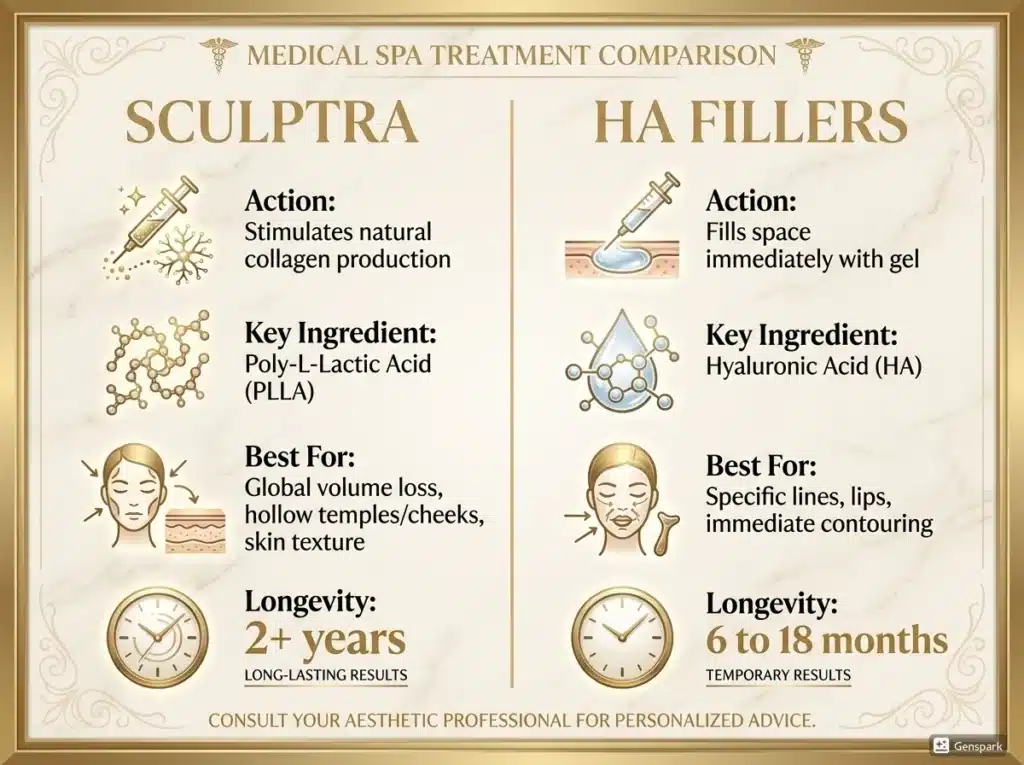
Overview of Sculptra vs Dermal FillersThis comparison of Sculptra bio-stimulant treatments and traditional dermal fillers highlights their distinct mechanisms and benefits. While dermal fillers use Hyaluronic Acid to provide immediate volume and contouring, Sculptra utilizes Poly-L-Lactic Acid to stimulate the body’s natural collagen production over time. The summary outlines the timeline of results, noting that fillers deliver instant improvement, while Sculptra requires patience for gradual, natural-looking results that can last over two years. Ultimately, the choice depends on aesthetic goals: fillers for quick, targeted enhancements, and Sculptra for long-term, global facial rejuvenation and structural support. |
How is Sculptra Bio-stimulant treatment different from Fillers?
To understand the difference, it helps to visualize how aging affects the face. As we age, we lose bone density, fat pads shrink, and, crucially, collagen production slows. This leads to sagging skin and a “hollowed” appearance. Both fillers and Sculptra address this, but their methods are distinct.
Traditional Dermal Fillers: The “Refill” Approach
Most traditional dermal fillers (like Juvéderm or Restylane) are made of Hyaluronic Acid (HA). HA is a naturally occurring substance in the skin that attracts and holds moisture. When injected, these fillers act like a gel cushion. They physically fill the space under the skin, smoothing out wrinkles or adding volume immediately.
Think of HA fillers as placing a pillow under a sagging bedsheet. The lift is mechanical and instant. Once the filler is injected, what you see is largely what you get (minus some initial swelling). These fillers are excellent for specific, localized concerns like thin lips, a crooked nose, or deep nasolabial folds. Patients often combine fillers with treatments such as Botox in Tulsa to enhance overall facial balance and wrinkle reduction.
Sculptra: The “Rebuild” Approach
Sculptra is not a filler in the traditional sense. It is a bio-stimulatory aesthetic injectable made of Poly-L-Lactic Acid (PLLA). It doesn’t just fill a space; it communicates with your body. When Sculptra is injected, the micro-particles of PLLA act as a scaffold. This stimulates your own fibroblasts (the cells responsible for creating connective tissue) to produce new collagen. Over time, the PLLA is naturally absorbed by the body and eventually disappears, but the new collagen structure remains. It reinforces the skin’s underlying structure, restoring facial volume and improving skin texture globally rather than just spot-treating wrinkles.
When Can You Expect Results with Sculptra?
One of the biggest mental shifts required when choosing Sculptra in OKC over fillers is patience. Because the mechanism of action relies on your body’s biological response, the gratification is delayed.
The Immediate “Tease”
Right after your Sculptra injection, you will look great. Your face will appear full and lifted. However, this is primarily due to the sterile water used to suspend the PLLA particles and some mild swelling. Within 24 to 48 hours, your body absorbs this water, and you might look exactly as you did before the treatment. This is normal, so don’t panic.
The “Glow” Phase (Months 1–3)
The PLLA micro-particles are now hard at work deep within the dermis. Your collagen production ramps up. You won’t wake up one morning with a dramatically different face; instead, the change is gradual. You might notice your skin looks firmer, glows more, and simply looks “healthier.”
The Peak (Months 3–6)
Most patients require a series of treatments (typically 2 to 3 sessions, spaced approximately 6 weeks apart) to achieve full correction. By the three- to six-month mark, the collagen structure has significantly rebuilt. The volume restoration looks incredibly natural because it is your own tissue.
Long-Term Maintenance
Once the desired result is achieved, Sculptra is impressive in its longevity. Results can last more than two years. Unlike HA fillers, which metabolize and dissolve, the collagen you have built is yours. Eventually, the natural aging process will continue, but you will be aging from a more rejuvenated baseline. Many patients enhance results by pairing Sculptra with skin-quality treatments such as a VI facial peel.
Making the Right Choice for Your Skin
Choosing between bio-stimulants and fillers is not about which product is superior, but which one solves your specific problem. If you have a wedding next week and want plump lips or sharper cheekbones, traditional HA fillers are your best bet. They provide the precision and immediacy required for contouring and quick fixes. However, if you are looking at the long game, focusing on overall facial rejuvenation, fixing hollow temples, or addressing widespread volume loss, Sculptra in Tulsa offers a solution that is often more subtle and natural-looking. It is particularly effective for those who want to avoid the “overfilled” or “puffy” look that can sometimes result from excessive HA filler use.
Consulting with a board-certified dermatologist at ORR Salon is the only way to get a definitive answer. Their experts evaluate your skin quality, volume loss, and bone structure to create a personalized treatment plan, which may even include a strategic combination of both options for optimal, natural-looking results.
Frequently Asked Questions
Q1. Does Sculptra hurt more than fillers?
Both treatments involve injections, so there is some discomfort involved. However, Sculptra is mixed with lidocaine (a numbing agent) before injection, which significantly reduces pain. Most providers also apply a topical numbing cream beforehand.
Q2. Can I combine Sculptra and fillers?
Yes, absolutely. Many practitioners use a “hybrid” approach. They might use Sculptra to build a foundation of volume and collagen in the cheeks and temples, and then use a small amount of HA filler to refine specific areas, such as the lips or under-eyes, where Sculptra is not recommended.
Q3. Is there downtime with Sculptra?
Downtime is minimal. You may experience some swelling, bruising, or tenderness at the injection sites, similar to regular fillers. The main difference in aftercare is the “5-5-5 rule”: you must massage the treated area for 5 minutes, 5 times a day, for 5 days to ensure the particles distribute evenly.
Q4. Is Sculptra reversible?
No. Unlike Hyaluronic Acid fillers, which can be dissolved with an enzyme called hyaluronidase if you don’t like the results, Sculptra cannot be reversed. You must wait for the effects to naturally wear off. This is why choosing an experienced, qualified injector is non-negotiable.